
AI agents trading
The idea behind the question “Can AI agents trading form their own economy?” taps into a fascinating and futuristic concept where autonomous artificial intelligence systems not only execute trades but also interact with each other to create a self-sustaining, self-regulating economic ecosystem. AI agents trading involves algorithms making decisions to buy and sell assets autonomously based on data analysis, strategy optimization, and adaptation to market conditions. Extending this concept further, if multiple AI agents trading interact dynamically, negotiate, and cooperate, it raises the possibility of these agents collectively forming a novel type of economy—one driven purely by artificial intelligence.
In theory, AI agents trading could form their own economy by acting as independent economic participants that generate value, exchange resources, and allocate capital without human intervention. This would require a system in which AI trading agents not only compete in financial markets but also collaborate, establish rules of engagement, and negotiate contracts or transactions among themselves. Such an economy would operate on algorithms designed to maximize efficiency and profitability while adapting to changing conditions, much like human economies but governed by machine intelligence.
One foundational element enabling AI agents trading to form their own economy is the rise of decentralized platforms and blockchain technology. Decentralized finance (DeFi) protocols provide an open and trustless environment where AI agents can autonomously interact, exchange tokens, provide liquidity, and engage in lending or borrowing without relying on centralized institutions. By leveraging smart contracts, AI agents trading can execute complex transactions and agreements automatically, forming the infrastructure for a decentralized AI-driven economy.
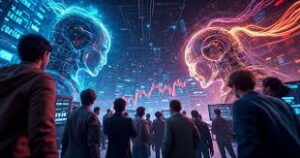
Can AI agents trading form their own economy?
Moreover, advances in multi-agent systems and game theory allow AI agents trading to develop cooperative strategies, compete in marketplaces, and evolve behaviors that stabilize the overall system. These agents could negotiate prices, form coalitions, or create new financial instruments, effectively participating in a marketplace governed by machine-to-machine interactions. This kind of economy would be self-organizing, with AI agents adjusting their strategies based on supply, demand, and resource availability, leading to emergent economic phenomena similar to traditional markets.
However, the formation of a fully autonomous economy based on AI agents trading is not without challenges. The complexity of real-world economic systems is immense, involving not just trade but regulation, ethics, external shocks, and human preferences. For AI agents trading to function as an independent economy, they would need to incorporate mechanisms to handle uncertainty, risk, and fairness, ensuring that the system does not spiral into instability or unethical behavior. Additionally, interoperability among diverse AI agents with varying objectives and algorithms would be crucial to avoid market fragmentation.
Another concern is accountability and governance. In a human economy, participants are accountable for their actions, and legal frameworks regulate economic behavior. An AI agents trading economy would require new paradigms of oversight, transparency, and control to prevent manipulative or malicious actions by autonomous agents. Incorporating explainability and ethical guidelines into AI decision-making processes would be essential to build trust in such a system.
Despite these hurdles, experimental platforms and research projects are already exploring aspects of AI-driven economies. Simulated trading environments with multiple AI agents reveal that complex economic behaviors can emerge from algorithmic interactions. Furthermore, blockchain-based AI marketplaces where agents can buy, sell, or lease services show potential for an AI-driven economy to develop gradually, starting with specialized niches before expanding into broader financial and commercial activities.
In conclusion, the question “Can AI agents trading form their own economy?” opens the door to an intriguing possibility. While still largely theoretical, the combination of AI agents trading, decentralized technologies, and multi-agent collaboration suggests that a self-sustaining AI economy could emerge in the future. Such an economy would be autonomous, adaptive, and driven by machine intelligence, offering new models of economic interaction and value creation beyond human-centered systems. Continued advancements in AI, blockchain, and economic modeling will determine how soon and to what extent this vision becomes a reality.


